


The National Film and Video Censors Board (NFVCB) plans to move away from traditional censorship and focus more on content classification as it reviews its film industry regulations.
The board hopes the change will help it keep pace with the growth of streaming platforms, social media and artificial intelligence (AI).
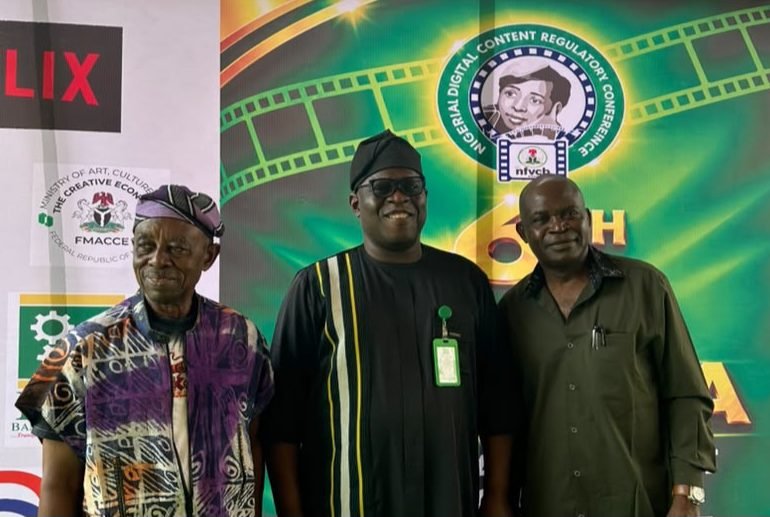
Shaibu Husseini, the board’s executive director, announced the plan at the sixth edition of the Peace Anyiam-Osigwe Nigerian Digital Content Regulatory Conference (PAO-NDCRC).
The conference took place on November 18 and 19 at the Muson Centre in Lagos. It focused on ‘Film and Content Production in the Digital Era: Balancing Regulation and Innovation’.
NFVCB reviews film regulation guidelines
Husseini said the “rapid expansion” of digital platforms and new technologies had changed how people produce, distribute and consume audiovisual content.
He said these changes had made it necessary for the board to review its existing practices.
Under the proposed system, the NFVCB will focus more on classifying content than traditional censorship. The approach will help audiences make informed viewing choices while protecting creative freedom.
Husseini also disclosed that a technical committee was reviewing the board’s classification, exhibition and distribution guidelines to reflect changes in the industry.
He added that the board was discussing a possible partnership with Germany’s Goethe University. The partnership would help digitise and preserve its audiovisual classification archive, which dates back to 1994.
The NFVCB also plans to work more closely with other government agencies and improve public awareness.
RMD seeks better earnings for Nollywood creatives
During the keynote address, actor Richard Mofe-Damijo (RMD) urged Nollywood filmmakers to look beyond box-office figures, production numbers and social media engagement.
He said the industry’s growing global popularity must translate into better financial returns for creative professionals.
RMD called for improved distribution rights, royalty tracking, licensing arrangements and fair compensation.
He also urged filmmakers to protect actors against the unauthorised use of their faces and voices through artificial intelligence.
The actor further stressed the need for filmmakers to understand contracts, intellectual property and commercial rights.
Musawa calls for government support
Hannatu Musa Musawa, minister of art, culture and creative economy, sent her special adviser, Moriam Ajaga, to represent her at the conference.
Ajaga stressed the need for continued government involvement and cooperation among industry stakeholders. She said these efforts would help strengthen Nigeria’s creative economy and film industry.
The conference honoured late filmmaker Peace Anyiam-Osigwe for her contributions to African cinema.
Attendees included filmmakers Mahmood Ali-Balogun and Femi Odugbemi, Evelyn Nwosu of the Nigerian Television Authority (NTA), Ziyanda Bulthelezi, Netflix’s head of public policy for Sub-Saharan Africa, and Raymond Osigwe of the Africa Movie Academy Awards.







Leave a Reply