

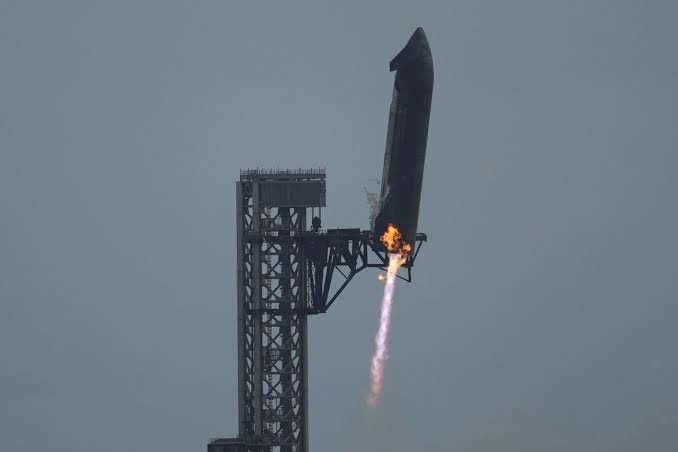

Elon Musk’s SpaceX has made history after Starship completed its first successful tower catch, marking a breakthrough for reusable spacecraft. The milestone came Saturday, November 14, when Starship returned to Starbase, Texas, after spending approximately twenty-two hours orbiting Earth successfully.
During its fifteenth integrated flight test, the spacecraft completed fourteen full Earth orbits and deployed twenty-six Starlink satellites before returning. Starship travelled at 17,000 miles per hour before atmospheric reentry, enduring intense heat as it descended towards the launch site.
After emerging through thick clouds, the spacecraft reignited three engines, adjusted its position, and guided itself towards the launch tower. Two enormous mechanical arms, nicknamed chopsticks, caught the descending spacecraft above the launch pad, completing an unprecedented recovery manoeuvre successfully.
Cheers erupted around Starbase as SpaceX teams celebrated the historic catch during a dramatic livestream watched by audiences worldwide online. This marked the first time SpaceX recovered a Starship spacecraft directly at its launch tower following a complete orbital mission.
Previously, the company had caught returning Super Heavy boosters, but recovering Starship presented greater engineering and technical challenges for recovery. The spacecraft descends from much higher altitudes and travels faster than boosters, making its controlled return especially difficult during reentry.
SpaceX aims to develop a fully reusable rocket system that could significantly reduce launch costs and increase future mission frequency. The successful Starship catch represents an important step towards that ambition, although engineers still face development challenges for future missions.
However, the Super Heavy booster failed to return during Friday’s flight, splashing down in the Gulf of Mexico instead offshore. Consequently, SpaceX did not achieve its planned recovery of both rocket stages during this particular test flight on Friday overall.
Nevertheless, Starship’s successful return demonstrated progress in heat-shield performance, engine control, navigation, and precision landing technology during this test successfully. NASA welcomed the milestone because Starship is expected to support Artemis missions, including plans to land astronauts on the Moon.
Elon Musk celebrated the achievement online, while SpaceX continues developing Starship for lunar exploration, Mars missions, and satellite deployment worldwide.








Leave a Reply