

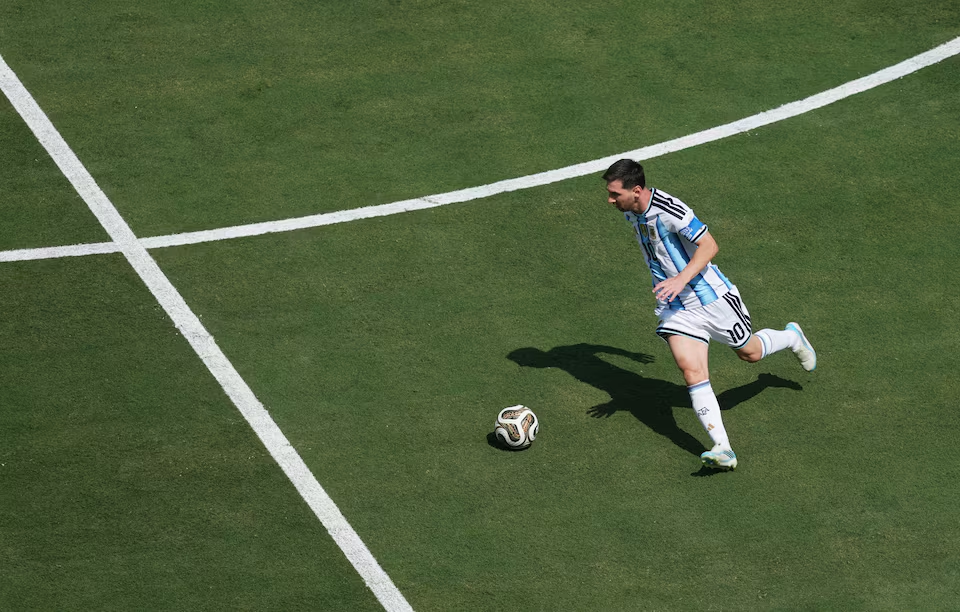

Lionel Messi’s final appearance for Argentina on Tuesday will close a long, hard-won love story between the football icon and a country that once struggled to recognise the teenage prodigy growing up far from home.
Messi’s farewell against Benin at Buenos Aires’ Monumental stadium will end an international career spanning more than two decades. During that time, his relationship with Argentina changed from doubt and criticism to widespread admiration.
Argentina struggled to find Messi
“He went through so many moments that they’re really very different eras. At first he suffered enormously with the national team. He truly endured it,” Argentine journalist and author Sergio Levinsky, who wrote “Messi and Everything Else”, told Reuters.
Messi moved to Barcelona as a teenager, where Spain tried to persuade him to represent the country. Argentina, meanwhile, was still trying to find the youngster who was developing his talent far from home.
At the 2003 Under-17 World Cup in Finland, Spain defeated Argentina 3-2 after extra time in the semi-finals.
Levinsky said Cesc Fabregas, then Messi’s teammate at Barcelona’s La Masia academy, told Argentine delegates afterwards: “You lost to us because we’ve got your best player at Barcelona and he’s a genius.”
Argentina youth coach Hugo Tocalli recalled a similar encounter. He said Spain’s head chef told him Argentina needed “a kid who plays in Barcelona” to win the tournament.
The search for Messi in Spain was not easy. Argentine Football Association employee Omar Souto found the Messi family through a Rosario telephone directory but initially asked for “Leonardo”.
“His name isn’t Leonardo, it’s Lionel,” Souto was told, according to the documentary “Messi: The Forgotten Tape”.
The confusion even reached official paperwork. The AFA reportedly sent Barcelona a fax asking about a player called “Mecci”, spelling Messi’s surname with a double “c” because officials believed he might be Italian.
From doubts to acceptance
Messi made his first appearances for Argentina in two Under-20 friendlies in 2004. But doubts followed him into the national team.
Some fans accused him of failing to reproduce his Barcelona form and labelled him “pecho frio”, questioning his passion for Argentina.
A 2011 World Cup qualifier against Colombia helped change that view. Messi inspired Argentina to recover from a goal down despite difficult conditions.
“He was exhausted, even vomiting, and he ended up winning,” Levinsky said. “It was the first time fans saw him differently.”
The bond grew stronger after Messi briefly retired following Argentina’s penalty shootout defeat by Chile in the 2016 Copa America final.
Instead of blaming him, supporters called for his return.
“People realised he was not responsible for the defeats. He was the one getting them to finals,” Levinsky added.
Messi becomes an Argentine icon
Under Lionel Scaloni, Messi became the leader of a new generation. He guided Argentina to two Copa America titles and the 2022 World Cup.
His leadership also drew comparisons with Diego Maradona, but Levinsky said the debate should not be about choosing one over the other.
“It is Messi and Maradona,” he said. “They were both geniuses in different eras.”
For Levinsky, Argentina’s love for Messi developed slowly. Unlike Maradona, whose connection with the country was formed at home, Messi grew up and built most of his career abroad.
“Messi was like suddenly finding out you have an 18-year-old son,” Levinsky said. “You have to start loving him without having known he existed. It was a love under construction.”







Leave a Reply