



Nigeria has been ranked sixth globally in its contribution to projected real GDP growth for 2026, according to fresh data released by the International Monetary Fund (IMF) , a notable boost for Africa’s largest economy.
The IMF estimates that Nigeria will account for 1.5 percent of global real GDP growth next year, placing it ahead of several advanced and emerging economies and reinforcing its role as one of the world’s key growth drivers.
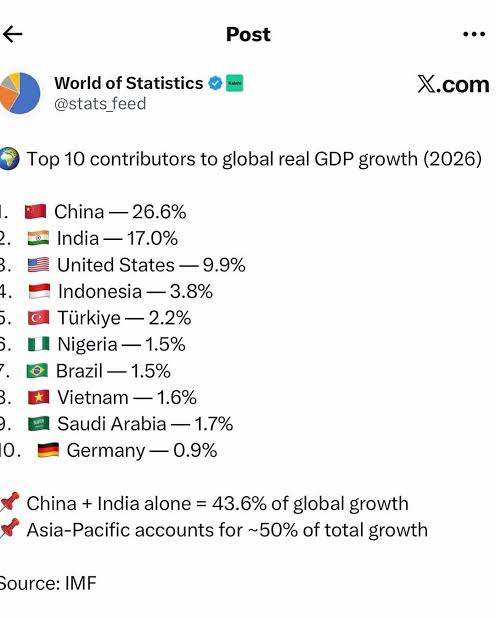
The projection comes from the IMF’s latest World Economic Outlook, which shows that global growth in 2026 will be driven largely by emerging markets rather than advanced economies, many of which continue to struggle with slow expansion, high interest rates, and post-pandemic pressures.
Nigeria’s ranking reflects a combination of factors, including population-driven economic activity, rising output in non-oil sectors, and gradual reforms aimed at stabilising the economy. Economists note that while Nigeria’s growth rate may appear modest compared to some peers, its sheer economic size means even incremental gains translate into a meaningful contribution to global output.

The IMF data places Nigeria among a small group of countries expected to significantly shape global economic performance in 2026. Analysts say this highlights the country’s growing influence beyond Africa, particularly as developing economies take on a larger share of global growth.
In recent years, Nigeria’s economy has been supported by expansion in telecommunications, agriculture, financial services, and the creative sector, alongside efforts to improve oil production and foreign exchange market efficiency. These developments have helped offset lingering challenges such as inflation, currency volatility, and infrastructure gaps.
Despite the positive outlook, the IMF and local economists caution that sustained growth will depend on consistent policy implementation, improved productivity, and measures that translate macro-economic gains into better living standards for citizens.
Still, the sixth-place ranking has been welcomed as a strong signal to investors and development partners, many of whom see Nigeria’s young population and large consumer market as long-term advantages if reforms continue.
As global economic momentum increasingly shifts toward emerging markets, Nigeria’s projected contribution underscores its position as one of the countries to watch in 2026 and not just within Africa, but on the world stage.









Leave a Reply