



Nollywood star and filmmaker Funke Akindele has reacted strongly to recent comments made by fellow filmmaker Kunle Afolayan regarding the growing trend of dancing and social media skits used to promote movies in Nigeria. The exchange has since sparked fresh conversations within the film industry about marketing, creativity, and evolving promotional strategies.

Kunle Afolayan made his remarks while speaking at a recent industry event where discussions centred on the current state of Nollywood, box office growth, and the influence of social media. During his address, Afolayan questioned the increasing reliance on dance challenges and viral videos to promote films, suggesting that such methods were not necessarily aligned with the kind of storytelling and cinematic culture he believes Nollywood should uphold.
While he did not directly name any individual, his comments were widely interpreted online as a critique of a trend largely associated with commercially successful filmmakers, particularly those whose movies have dominated cinema conversations in recent years. Clips and summaries of his remarks quickly circulated on social media, prompting debates among filmmakers, actors, and fans.

Shortly after, Funke Akindele appeared to respond through a series of pointed statements shared publicly. Without mentioning Afolayan by name, she made it clear that she felt unfairly targeted by narratives suggesting that certain filmmakers were blocking others’ progress.
“I’m not the one hindering your progress,” Akindele said, adding in Yoruba, “Ka rin ka po, yiye ni n ye ni,” a phrase often interpreted as encouragement to focus on one’s own journey and hustle. Her words were widely seen as a direct response to the criticism of promotional styles that have contributed to her films’ box office success.


Funke went further, addressing what she described as misplaced resentment within the industry. “If you can’t beat them or join them, create your own path,” she said. “No allow jealousy burn you. The sky is so big for everybody to fly.” The statement resonated with many of her supporters, who praised her confidence and refusal to apologise for strategies that have worked for her brand.
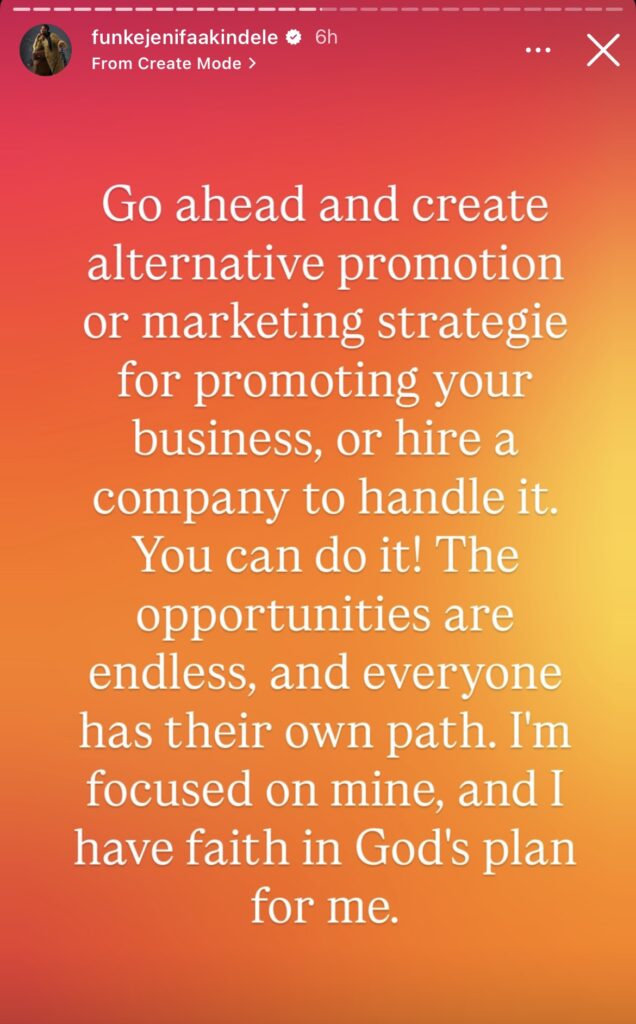
She also challenged filmmakers and creatives to think beyond complaints and take responsibility for how they promote their work. According to Akindele, Nollywood is no longer operating in a one-size-fits-all era, and success now depends on adaptability. “Go ahead and create alternative promotion or marketing strategies for promoting your business, or hire a company to handle it,” she said. “You can do it. The opportunities are endless, and everyone has their own path.”
Her comments quickly gained traction online, with fans and industry observers weighing in. Some agreed with Kunle Afolayan’s concern about preserving artistic depth and originality in film promotion, while others sided with Akindele, arguing that modern audiences respond to creativity, visibility, and engagement, regardless of the format.
The debate highlights a growing divide in Nollywood between traditional filmmaking values and the realities of a digital-driven entertainment economy. With cinema competition intensifying and audience attention increasingly fragmented, many filmmakers are experimenting with unconventional marketing approaches to stand out.
Funke Akindele’s films, in particular, have consistently recorded strong box office performances, often supported by aggressive social media campaigns that blend humour, dance, and relatability. To her supporters, these strategies reflect innovation rather than compromise.
As reactions continue to unfold, neither side has indicated an intention to escalate the exchange further. For now, the conversation has reignited broader discussions about how Nollywood can balance artistic integrity with commercial survival in an industry shaped by algorithms, virality, and changing audience tastes.
The spotlight remains on how filmmakers choose to navigate promotion going forward, especially as Nollywood continues to attract global attention and higher commercial stakes.









Leave a Reply