

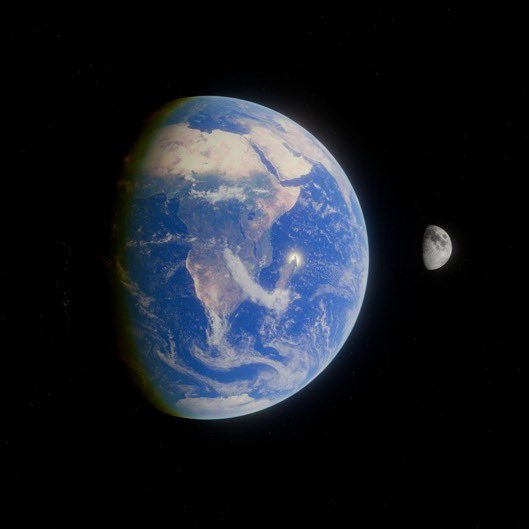

Earth’s temporary second moon, asteroid 2026 QQ8, is currently travelling near our planet after gravity captured it earlier this year. The tiny visitor offers astronomers a rare opportunity to study how passing space rocks briefly become temporary companions of Earth.
According to the International Astronomical Union’s Minor Planet Center, 2026 QQ8 entered a gravitationally bound orbit around Earth in April. Hungarian astronomer Krisztián Sárneczky first spotted the object on August twentieth, months after its temporary capture had apparently begun there.
Its natural origin was confirmed after follow-up observations ruled out the possibility that it was artificial space debris from spacecraft. Measuring approximately one to two metres across, 2026 QQ8 is closer to human-sized than the size of an ordinary car.
Despite its nickname, this minimoon looks nothing like the familiar Moon and remains far too faint for unaided human eyes. Researchers estimate that the asteroid currently travels approximately one-and-a-half times farther away than the Moon’s average distance from Earth.
That enormous distance, combined with its extremely small size, makes 2026 QQ8 impossible to observe without sensitive professional telescope equipment. The temporary satellite is expected to remain under Earth’s gravitational influence through December before escaping into its independent solar orbit.
Some projections place its departure in January 2027, meaning Earth could lose its temporary companion at the beginning of next year. The asteroid follows an orbit around the Sun lasting approximately 359 days, bringing it close to Earth about every decade.
This year’s close approach allowed Earth’s gravity to capture the passing object, creating the unusual temporary arrangement astronomers recently confirmed. Experts say 2026 QQ8 poses no meaningful danger because its body would likely burn up if it entered Earth’s atmosphere.
Earth has hosted other temporary moons before, including objects discovered in 1991, 2006, 2020 and more recently during subsequent surveys. Most minimoons remain close to Earth for less than a year, although some objects stay within its gravitational influence longer.
Earth’s temporary second moon therefore provides a timely reminder that our planet’s neighbourhood contains many small visitors still awaiting discovery.








Leave a Reply