



Nigeria went dark again.No warning. No real explanation. Just another nationwide blackout caused by the now-familiar phrase: “national grid collapse.”
From Lagos to Abuja, Port Harcourt to Ibadan, Enugu to Kano, electricity supply dropped across the country, disrupting homes, businesses, hospitals, and daily life.Yesterday several news platforms publicized that the national grid has fallen for the first time in the new year, 2026.
For many Nigerians, the frustration wasn’t just about losing light. It was about the question we’ve been asking for decades: why does this keep happening?
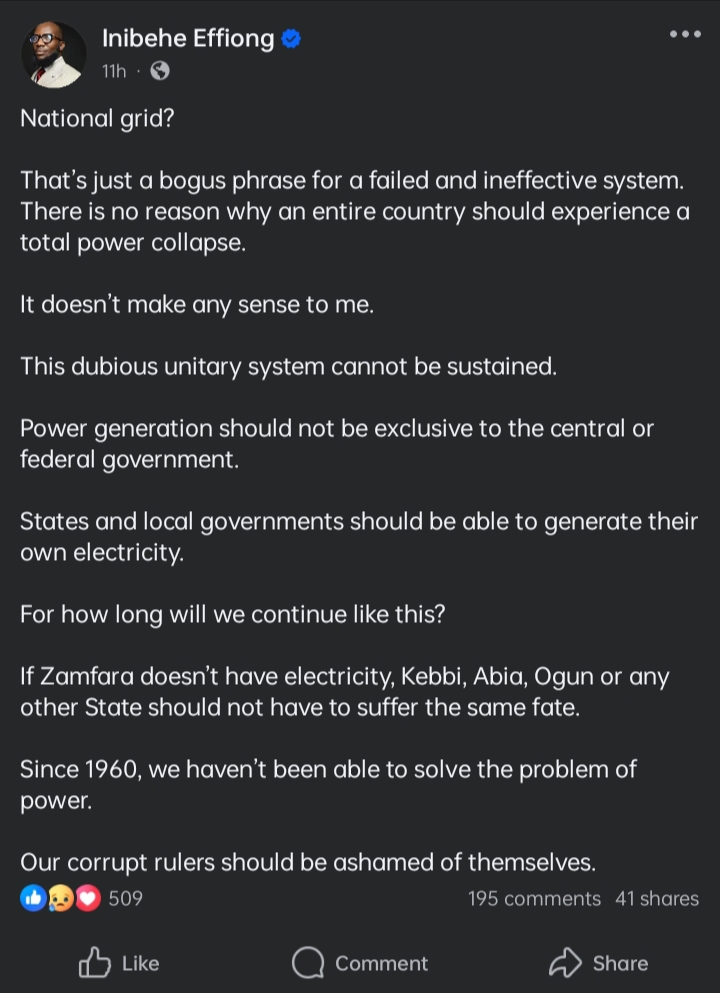
Human rights lawyer Inibehe Effiong gave voice to that frustration with a blunt response that quickly resonated across social media.
Inibehe Effiong is a Nigerian lawyer, activist, and public commentator known for holding power to account and speaking plainly about governance failures. Whether on issues of human rights, justice, or public infrastructure, he has consistently challenged systems that fail the people they are meant to serve.
Reacting to the grid collapse, Effiong described the “national grid” as a bogus phrase masking a failed and ineffective system. In most countries, a grid failure in one region doesn’t shut down an entire nation. There are buffers, alternatives, and decentralised structures that prevent total collapse.
Nigeria’s system doesn’t work that way.
Here, a single fault can throw the entire country into darkness. That reality exposes a power sector that is over-centralised, poorly maintained, and dangerously fragile. The transmission infrastructure meant to carry power from generating plants to distribution companies remains the weakest link, unable to absorb shocks or prevent cascading failures.
So when something goes wrong, everything goes wrong.“Why Must Everyone Suffer?”
This is the heart of Effiong’s argument.Why should one state’s problem become every state’s punishment?
If Zamfara has power issues, why must Ogun, Abia, or Rivers also sit in darkness?
According to him, and many Nigerians agree, electricity generation should not be the exclusive preserve of the federal government. States and even local governments should have the freedom to generate their own electricity, manage it, and insulate their people from national failures.
This isn’t rebellion. It’s common sense and it’s how functioning federations operate.
Since 1960, Still No Light
Perhaps the most painful part of Effiong’s reaction was the reminder that Nigeria has struggled with electricity since independence. Over sixty years later, power supply remains unreliable, expensive, and inadequate.
Different administrations have come and gone. Reforms have been announced. Committees have been set up. Yet the average Nigerian still plans their life around outages and fuel costs.
At some point, power failure stops being a technical issue and becomes a moral one.
Electricity failure isn’t just about comfort. It affects:
Businesses and productivity
Healthcare delivery
Education
Security
Quality of life
So when Nigerians express anger, it isn’t entitlement; it’s survival.
Effiong’s words struck a nerve because they reflected a truth many have normalised but shouldn’t have to: a country cannot grow in perpetual darkness.
This latest collapse has once again exposed the limits of Nigeria’s centralised power system. What the country needs isn’t another explanation, it’s structural change:
Decentralised power generation
Stronger, modern transmission infrastructure
Real state-level participation in electricity
Long-term planning instead of emergency responses
Until then, “national grid collapse” will remain a recurring headline and voices like Inibehe Effiong’s will continue to echo the frustration of a nation that deserves better.









Leave a Reply