


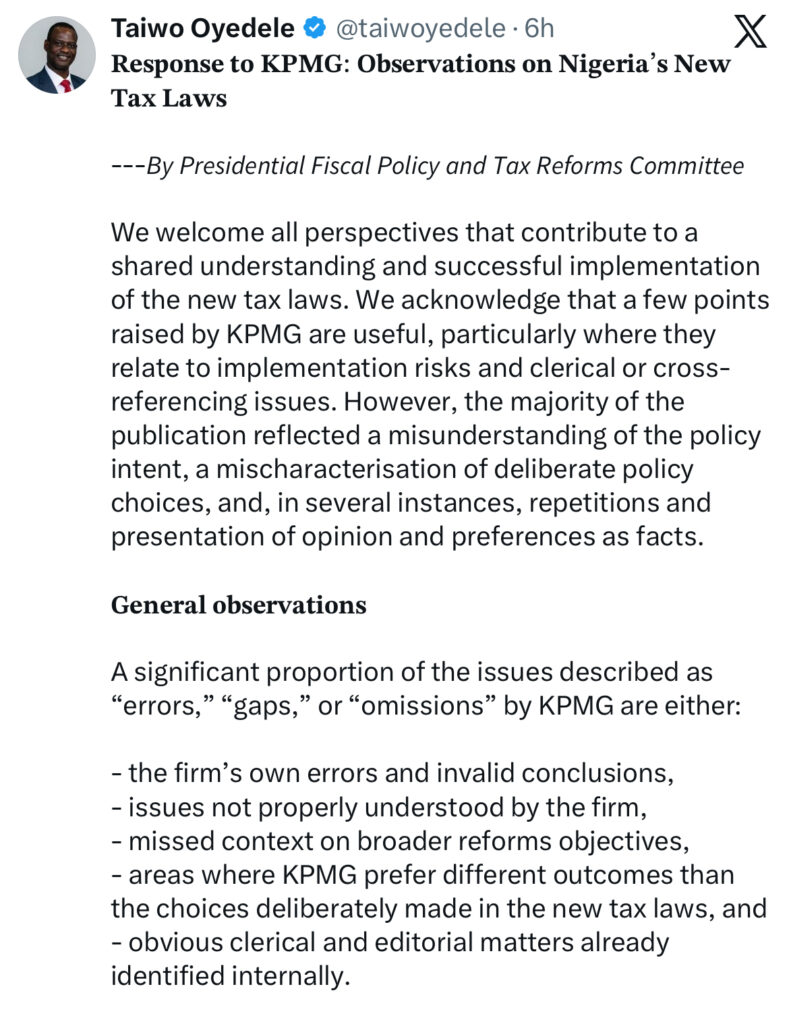
Taiwo Oyedele, chairman of the Presidential Fiscal Policy and Tax Reforms Committee, has publicly responded to concerns raised by KPMG regarding Nigeria’s recently enacted tax laws. In a statement, Oyedele emphasized that while some observations by the global accounting firm were useful, the majority reflected misunderstandings of the policy intent, mischaracterizations of deliberate choices, and a presentation of opinion as fact.
Oyedele highlighted that several issues KPMG flagged as “errors” or “gaps” were actually misinterpretations of policy, misunderstandings of broader reform objectives, or clerical and editorial matters already identified internally. He argued that disagreement with the government’s tax policy is valid, but it should not be framed as a failure or omission in the law. According to Oyedele, a more effective engagement would have been direct consultation, similar to how other professional firms contributed at the drafting stage.

In his statement, Oyedele addressed specific areas of misinterpretation by KPMG, including the taxation of shares and the stock market. Contrary to KPMG’s presumption that the law would trigger a market sell-off, Oyedele clarified that the chargeable gains tax is graduated from 0% to a maximum of 30%, which will later reduce to 25%, with most investors qualifying for exemptions or reinvestment benefits. He noted that recent stock market performance reflects investor confidence that the new tax laws strengthen corporate fundamentals rather than destabilize the market.
Oyedele also explained that KPMG’s suggestion to align the commencement date of the tax reforms with the start of an accounting period failed to account for the complexity of the transition. He stated that the law spans multiple accounting bases, audit considerations, deductions, and continuous transactions, and a simplified approach would not address these intricacies. He defended the indirect transfer of shares provision, describing it as aligned with global BEPS initiatives and necessary to close loopholes exploited by multinationals.
Other points addressed included VAT exemptions on insurance premiums, where Oyedele argued that the law correctly treats insurance as a non-taxable supply, making KPMG’s proposal unnecessary. He also clarified definitions, such as the inclusion of “community” in taxable entities, the composition of the Joint Revenue Board, distinctions in dividend taxation for foreign and Nigerian companies, and the treatment of non-resident registration and final tax. Each, he said, represents deliberate policy choices rather than errors.
Oyedele also responded to what he described as KPMG’s proposals that could undermine key reform objectives. For instance, the suggestion to exempt foreign insurance premiums from taxation would harm local insurers, while allowing deductions for parallel market forex rates would weaken fiscal and monetary policy coordination. Similarly, measures related to VAT compliance and progressive income tax were defended as aligned with fairness, progressivity, and international competitiveness, noting that Nigeria’s top marginal tax rate remains comparable to other nations.
Finally, Oyedele pointed out factual inaccuracies in KPMG’s analysis, such as references to the Police Trust Fund, which expired in 2025, and the treatment of small company exemptions, which predated the new tax laws. He urged stakeholders to focus on dynamic engagement and partnership with the government, emphasizing that the new laws represent a bold step toward a self-sustaining and competitive Nigerian tax system, with administrative guidance and regulatory clarifications to follow.
KPMG’s Initial Observations
In their report, KPMG had identified potential gaps, errors, and ambiguities in Nigeria’s new tax laws. The firm raised concerns about possible market impacts from share taxation, the VAT treatment of insurance, the commencement date of reforms, indirect share transfers, and inconsistencies in definitions such as taxable persons. They also questioned the composition of the Joint Revenue Board and the treatment of dividends, as well as issues related to tax deductions for foreign exchange, compliance-linked VAT measures, and the top marginal personal income tax rate.
KPMG described some of these provisions as having the potential to create uncertainties for investors and taxpayers, and suggested changes they believed would strengthen clarity, reduce perceived risks, and enhance economic competitiveness.
Oyedele’s response, however, frames these observations as misinterpretations and policy disagreements, while reiterating that the reforms are intentional, carefully considered, and designed to harmonize Nigeria’s tax system with global best practices while protecting domestic industries.









Leave a Reply